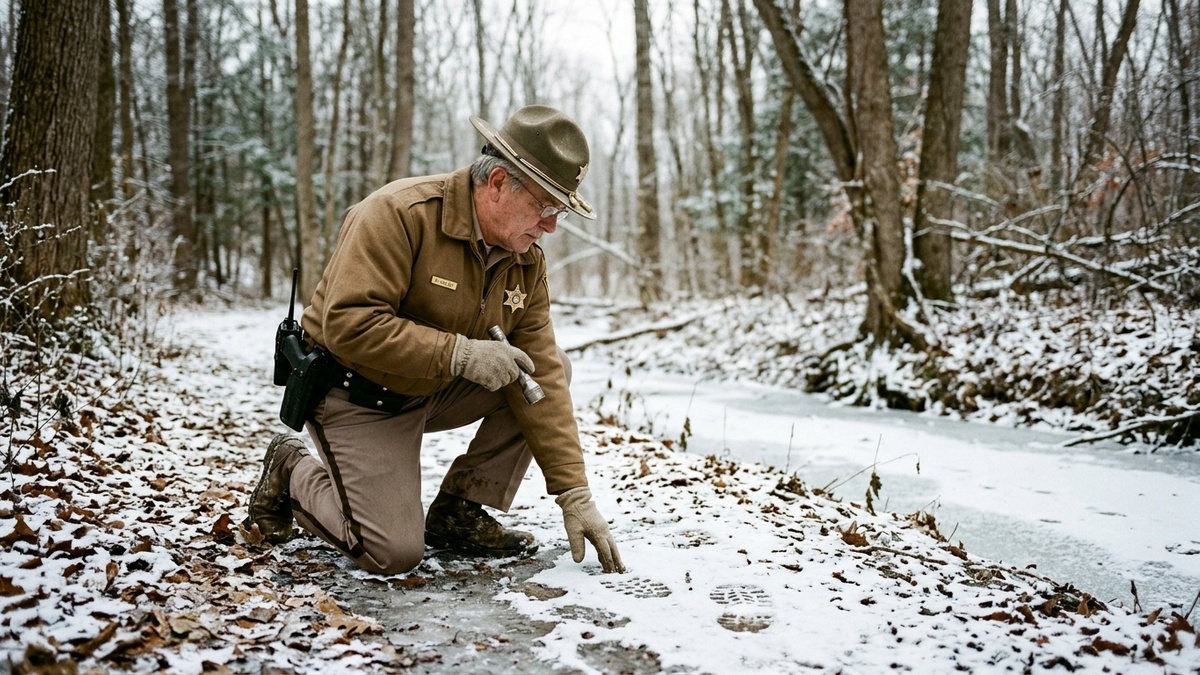
The drive to Marietta usually took Earl thirty-five minutes. That afternoon, it took an hour and ten. The snow came down thick and wet. Twice he passed cars in the ditch and stopped to make sure the drivers were all right, because he was the sheriff and that was the job, even on Christmas Eve.
June's photograph rode on the dashboard of the Crown Victoria the whole way. She had loved Dot's Christmas Eve supper. She used to bring a pan of her scalloped potatoes every year, and wear a red sweater, and help carry plates.
"Help me out here, June," Earl said to the photograph somewhere around the county line. "I could use it."
Lou was waiting at the front counter with the box.
It was a heavy cardboard carton, gray with dust, sealed with old brown tape that had gone brittle. Somebody had written on the side with a marker, a long time ago. RANGE PARTS. KEEP.
Lou slit the tape with his pocketknife. They both looked inside.
There were burner grates. There were knobs, a dozen of them, cream-colored with chrome rings. There were igniter springs and pilot tubes and a bag of brass fittings.
And at the bottom, wrapped in newspaper from the Parkersburg paper dated 1993, there was a heavy brass valve the size of Earl's fist, with the same maker's name stamped into it as the plate on Dot's range.
Earl picked it up. He turned it over in his hands.
"What do I owe you, Lou?"
Lou looked at him for a long moment.
"That's for Dot Kessler's place, right?"
"It is."
"My wife and I ate at that counter on our first date," Lou said. "1971, before Dot owned it. She kept the same pie." He pushed the box across the counter. "Take the whole thing. Merry Christmas."
It was three-forty when Earl pulled up at Main and Elm.
The diner was full. Not with diners. With people. Walt Brenner was in the kitchen with his toolbox. Hank Doyle was there, and Clay Hollister, and Pastor Greer. Ruth Ann Mercer had brought a box of candles in case the lights went too. Tyler was on his phone, and Dot sat on her stool by the dead range with her hands in her lap.
The gas company man had come back on his own time. He was a young fellow from Zanesville named Kevin, and he stood in the kitchen doorway in his coat and his work boots looking embarrassed.
"Ma'am, I called my supervisor," Kevin said. "If somebody finds the right valve, and I install it, and I test it, I can sign off on it. It's a repair, not a new hookup. No inspector needed."
Earl walked into the kitchen and set the brass valve down on the counter in front of him.
Kevin looked at the valve. He looked at the name stamped on it. Then he looked at the brass plate on the front of Dot's range.
"Huh," he said, very quietly. "Would you look at that."
It took Kevin an hour and a half, with Walt Brenner handing him tools and Hank Doyle holding the light and listening to every sound the old range made with his head cocked to one side, the way he listened to an engine. At five-fifteen, Kevin tightened the last fitting and tested every joint with a squeeze bottle of soapy water, slowly, twice. No bubbles.
He turned to Dot.
"It's your range, ma'am," he said. "You light it."
Dot got up off her stool. She took a kitchen match from the box on the shelf. Her hand was not steady.
She struck the match. She turned the front left knob.
The hiss came. Then the smell of gas, faint and familiar. Then a soft blue flame bloomed up around the burner and settled into a steady ring.
For a moment, the kitchen was silent. Then the whole diner cheered.
Dot did not cheer. She stood in front of the range with the spent match in her fingers, looking down at the flame. Then she turned around, and her eyes found Earl standing in the kitchen doorway with his hat in his hands.
Supper went out at six-thirty, half an hour late. Seventy-three people, the most Dot had ever fed on Christmas Eve. Ham and scalloped potatoes and green beans and four kinds of pie. Lou came out from Marietta with his wife, who was eighty and wore a red sweater.
Earl sat in the corner booth with a plate he did not remember filling. Dot came over at a quarter to nine, when the rush was done, and sat down across from him.
She did not say anything for a while.
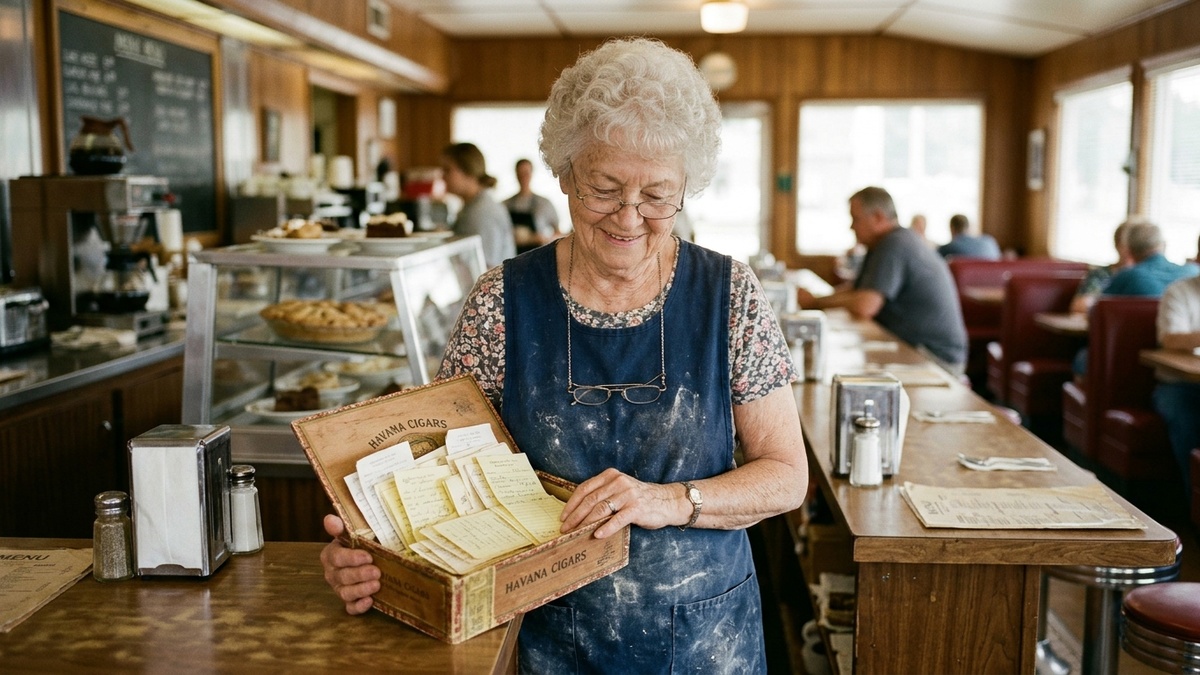
"Eleven months," she said finally. "Grilled cheese and soup. Every day. I never once wrote it down."
"I know," Earl said. "I did."
Dot looked at him.
Earl reached into his jacket pocket and took out a folded piece of lined paper, yellow with age and soft at the creases. He had carried it in his wallet since 1987. He unfolded it on the table.
It was a list. Two hundred and twenty-two lines, in a young man's handwriting. A date on every line. And beside every date, two words.
Grilled cheese.
At the bottom, in the same handwriting, it said: Pay Dot back someday.
Earl folded it up again and slid it across the table to her.
"Paid," he said.
Dot Kessler put the paper in the pocket of her apron, over her heart. Then she got up, went to the kitchen, and came back with two cups of coffee and a slice of sour cream raisin pie, and set it down in front of him.
"On the house, hon," she said, the way she had said it to a laid-off boy of twenty-three every weekday for eleven months.